How a Bacong Fiesta Turned Me Into a Pickleball Player (and Why I Built Picklr)
I declined every pickleball invite from my Cebu friends — until a fiesta in Bacong, a birthday at the Pikol Pol courts, and 8 hours of laughter changed my mind. The story of my first pickleball game, my first paddle, and the app that came after.
For months, I said no.
Friends here in Cebu kept inviting me to their pickleball nights. “Come try it.” “It’s fun, you’ll love it.” “We need a fourth.” Every time, I came up with a reason to skip — work, traffic, dinner plans, “maybe next week.” Honestly, I just wasn’t interested. I’d seen the YouTube clips. A small paddle, a plastic ball with holes, a court that looked like badminton had a baby with table tennis. It didn’t pull me in.
That stalemate ended on a trip to Bacong.
The fiesta that changed my mind
Bacong is the next municipality south of Dumaguete City — quiet, coastal, the kind of place where the fiesta runs all weekend and you eat lechon at three different houses before lunch. It also happens to be a stone’s throw from what people are now calling the pickleball capital of the Philippines: Dumaguete itself, where new courts have been popping up faster than restaurants.
One of my closest friends — Maia ❤️ — from work invited a few of us to her hometown for the fiesta. We said yes — for the lechon, mostly. I had zero plans to play pickleball.
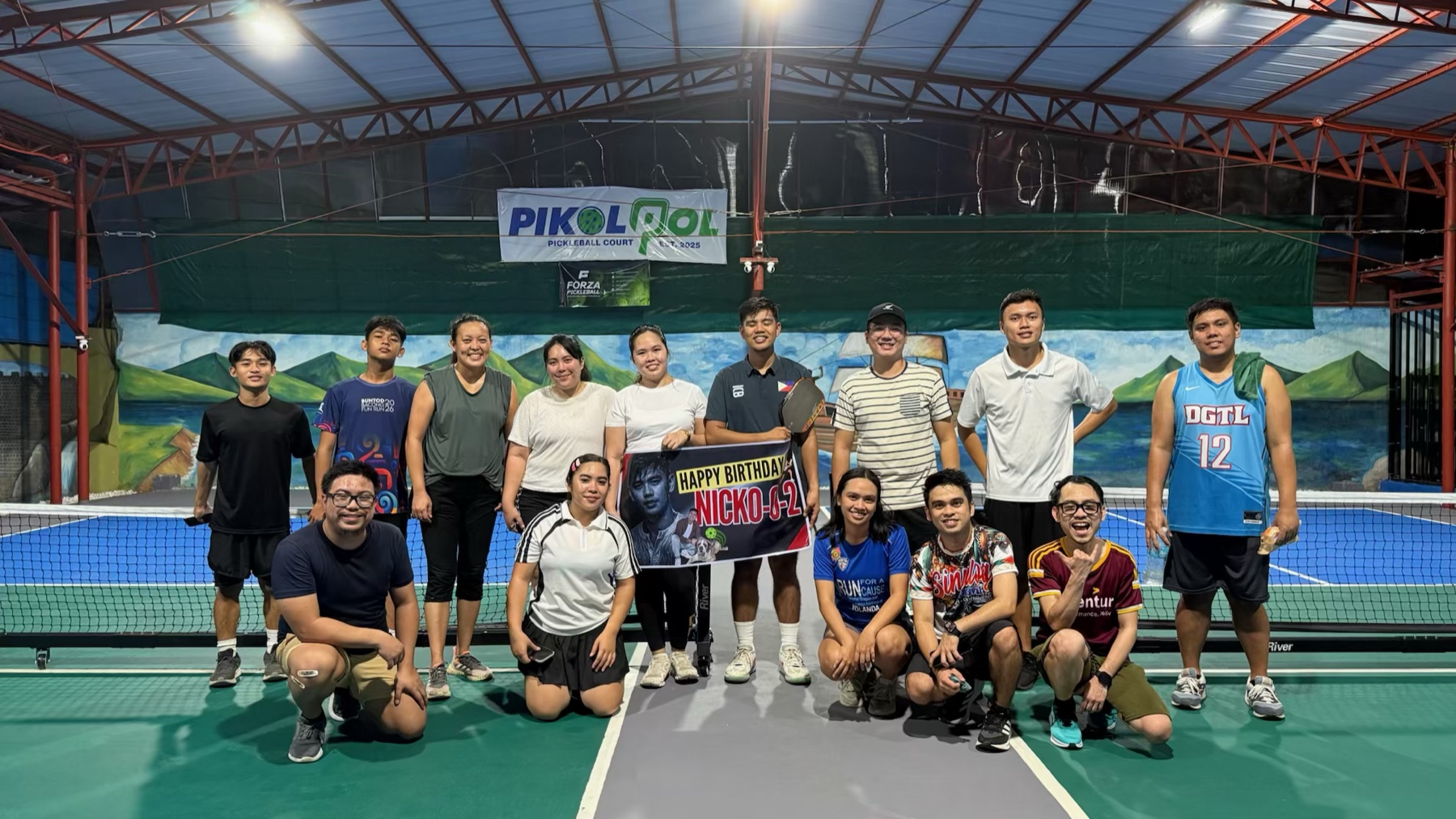
Then the first night rolled around, and we got invited to celebrate our friend Nicko’s birthday. At a pickleball court.
The court was called Pikol Pol — an indoor venue with two playable courts under a green metal roof and a hand-painted seascape mural along the back wall. Fluorescent lights, mismatched paddles in a bin, the smell of court paint still in the air. Nicko was holding a “HAPPY BIRTHDAY NICKO” banner. People were already playing.
“Just try one game,” someone said.
First impressions: ping-pong, but bigger
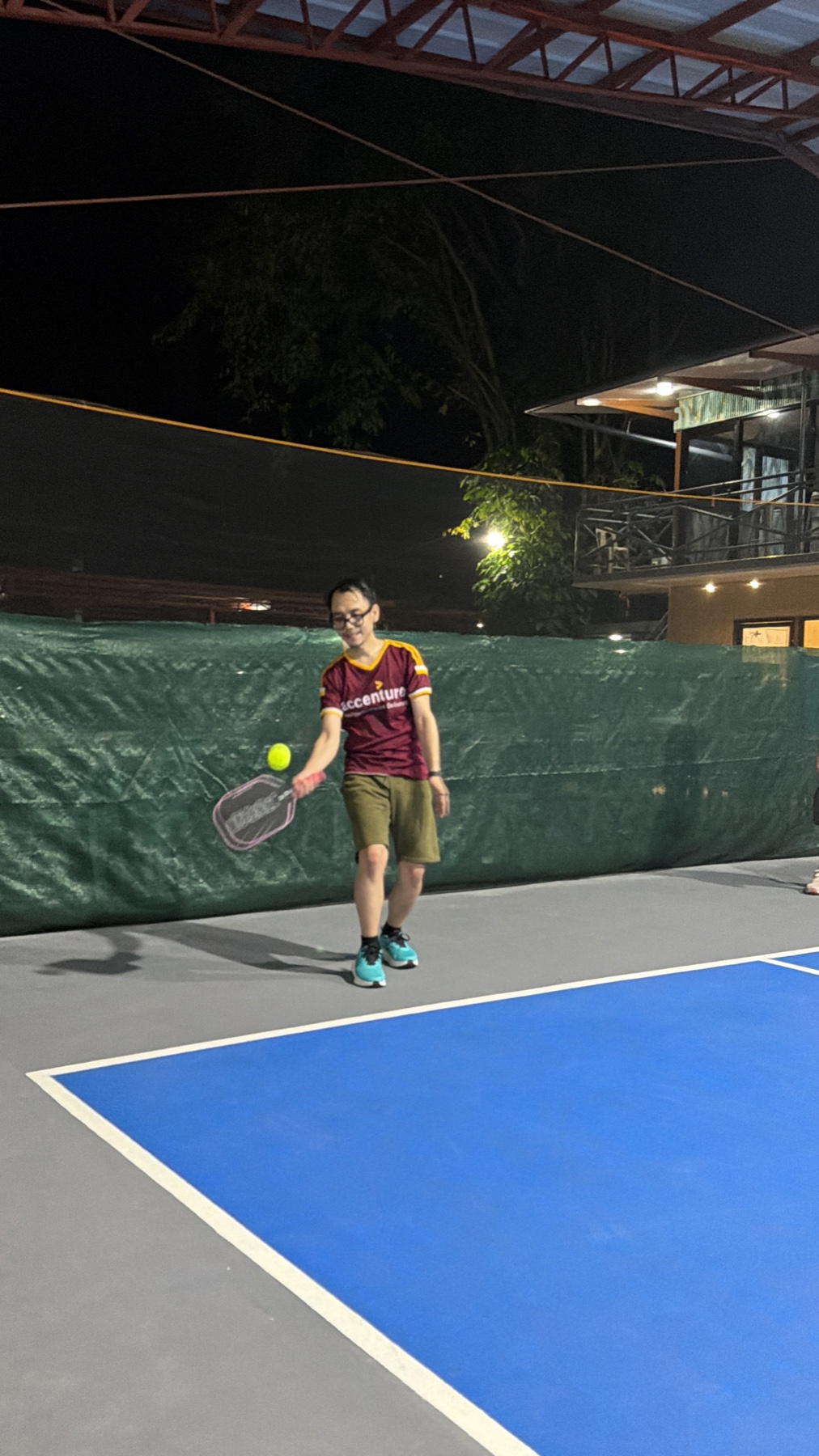
I borrowed a paddle. Heavier than I expected. Solid. The ball was lighter than I expected — a hollow plastic thing that sounded like a soft tap when you hit it, nothing like the pock of a tennis ball.
My honest first impression: this is ping-pong on a bigger table, played in a badminton court. I said that out loud. People laughed. Then somebody said “okay, you’re serving,” and the game started before I had time to ask any questions.
The next 45 minutes were chaos.
- Balls flying out beyond the back line, because I was hitting them like tennis groundstrokes.
- Balls lobbing so high they hit the metal ceiling — twice — and rolling onto the next court.
- Me running into the kitchen line to volley, getting yelled at (“no volley in the kitchen!”), then doing it again three minutes later because I forgot.
- Everyone stopping play to pick up balls scattered across two courts.
It wasn’t pretty. But somehow — and I still can’t fully explain it — it was fun. The kind of fun where you don’t notice you’re sweating until you stop. The kind of fun where the score doesn’t matter because you’re laughing too hard between points to keep track.
Learning the rules while playing
I’d played for maybe two hours before I could state the rules correctly. The way pickleball is taught in the middle of an open-play session is messy. You learn by being yelled at — affectionately — when you get it wrong.
By the end of that first night, I had the basics:
- Serve underhand, below the waist. Diagonally to the opposite service box.
- The score is announced as your score — their score — server number (the “1” or “2” after the two numbers tells your partner who’s serving).
- Two-bounce rule: after the serve, the ball must bounce once on the receiving side AND once on the serving side before either team can volley. Two bounces, then it’s open.
- No volleys inside the kitchen (the 7-foot zone next to the net). You can step in to play a bounced ball, but you cannot hit a volley while standing in it.
- Games to 11, win by 2. Only the serving team scores points.
Simple in theory. Catastrophic in practice for someone who’s only ever swung a tennis racket and a badminton racket. Pickleball asks you to slow down your shots in a way neither of those sports does. You can’t just smash everything. The dink — that soft little drop shot over the net — is the whole game.
By the end of the night, I was sore, sweaty, and asking when the next session was.
Day two: four more hours
The next day, Nicko called again. “Different court tonight.” Another pickleball venue. Same group. Without hesitation this time, I said yes.
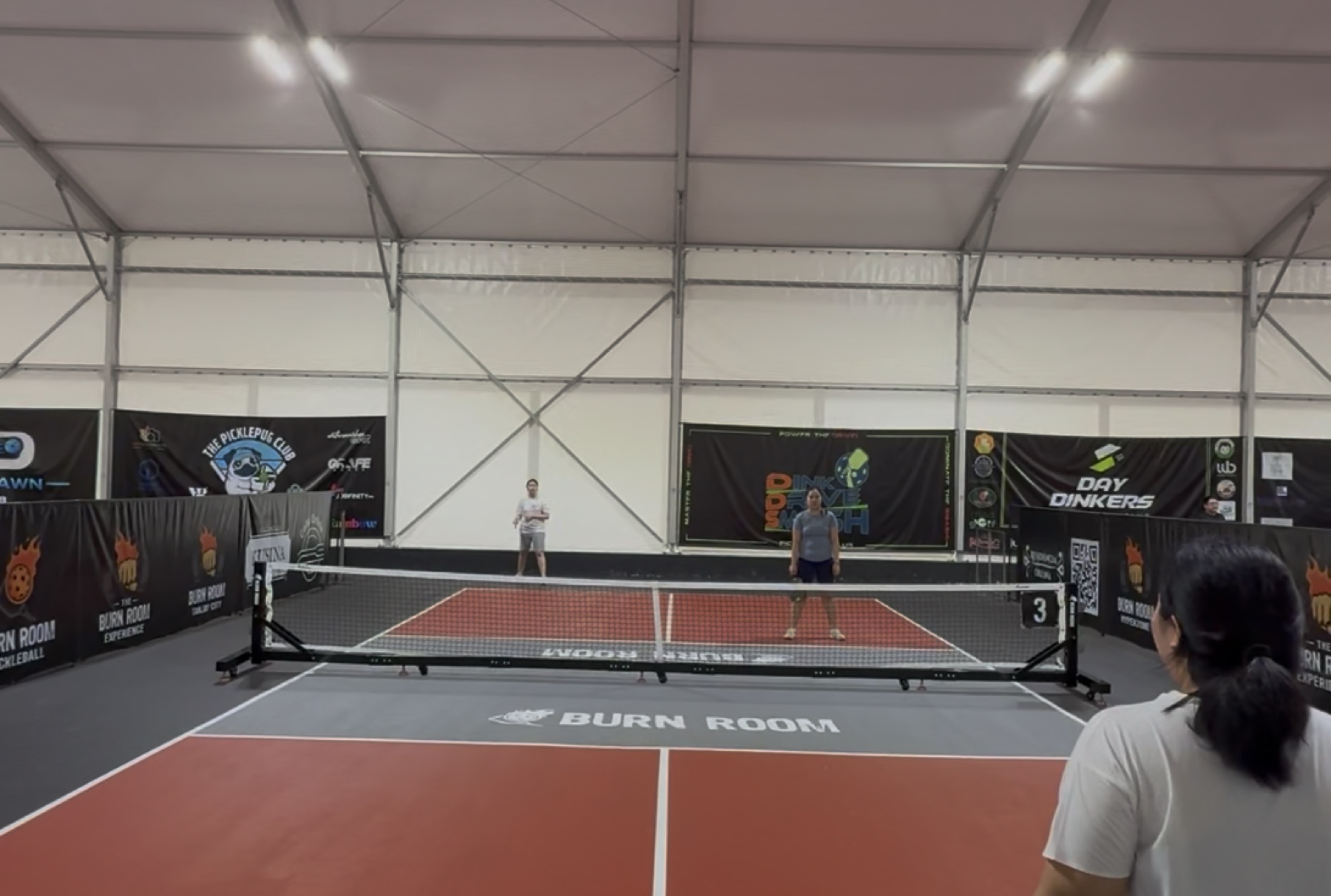
We played for four straight hours. Somewhere in those four hours, the scoring clicked. The two-bounce rule clicked. I started — started — to understand when to dink and when to drive. When to stand at the kitchen line and when to back up.
I lost most of my games. It didn’t matter. I was learning at the speed I could only learn while actually playing, with people who were patient enough to call out “yours!” and “mine!” until I figured out positioning.
What hit me most that night wasn’t the sport. It was the social texture of it.
- You’re never standing still — even between games you’re chatting with the team going on next.
- The court is small enough that everyone can hear everyone, so trash talk lands.
- A bad shot is recoverable in three seconds; a great rally takes thirty.
- Nobody cares how new you are. The skill ceiling is high, but the floor is low enough that beginners aren’t a liability — they’re just another body on the court.
I’d been to plenty of basketball nights, volleyball nights, even badminton tournaments. None of them had the texture of those two pickleball evenings in Bacong.
Buying my first paddle (and the Sypik problem)
Back at Maia’s house — where we were staying for the fiesta weekend — I dropped onto the couch with my phone and started searching. Eight hours of pickleball over two nights had convinced me of something: I needed my own paddle. I’d been borrowing whatever was in the bin at Pikol Pol, and most of those paddles had clearly seen better days — chipped edges, peeling grip tape, dead spots in the face from being smacked into court fencing. Borrowing was fine for two sessions; if I was going to keep playing, I needed something that actually felt like mine.
The paddle I wanted: Sypik Triton Ultimate Pro 5. I’d been hitting with one at Pikol Pol — a beautiful 16mm carbon-fiber face, gold-and-black design, balanced weight. It felt right.
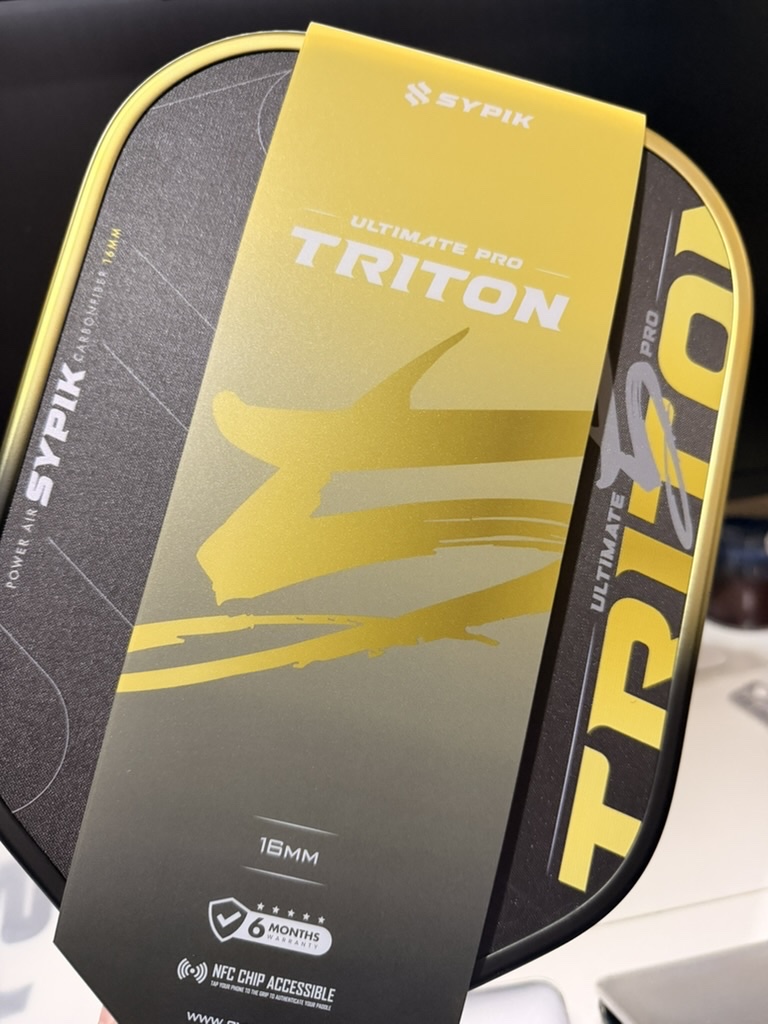
The problem: every “Sypik” listing I found on the Philippine resellers looked sketchy. No authorized-mall stamp, no SM/Decathlon/Toby’s Sports verified-seller badge, prices that were either too cheap or too high. The Triton retails for around ₱9,000+ if you can find a real one, and the listings I was seeing didn’t have any of the markers I’d want before spending that. I refuse to drop nine grand on a paddle that might be a Lazada-special knockoff.
So I pivoted. Next option that I could verify through a real store: Wilson Blaze Tour 16mm. Wilson has the brand recognition, the USA Pickleball stamp on the face, and an actual physical retail presence in the Philippines. It’s not the boutique paddle the Sypik would have been, but it’s a real, serious, ratings-grade paddle for an Intermediate player.
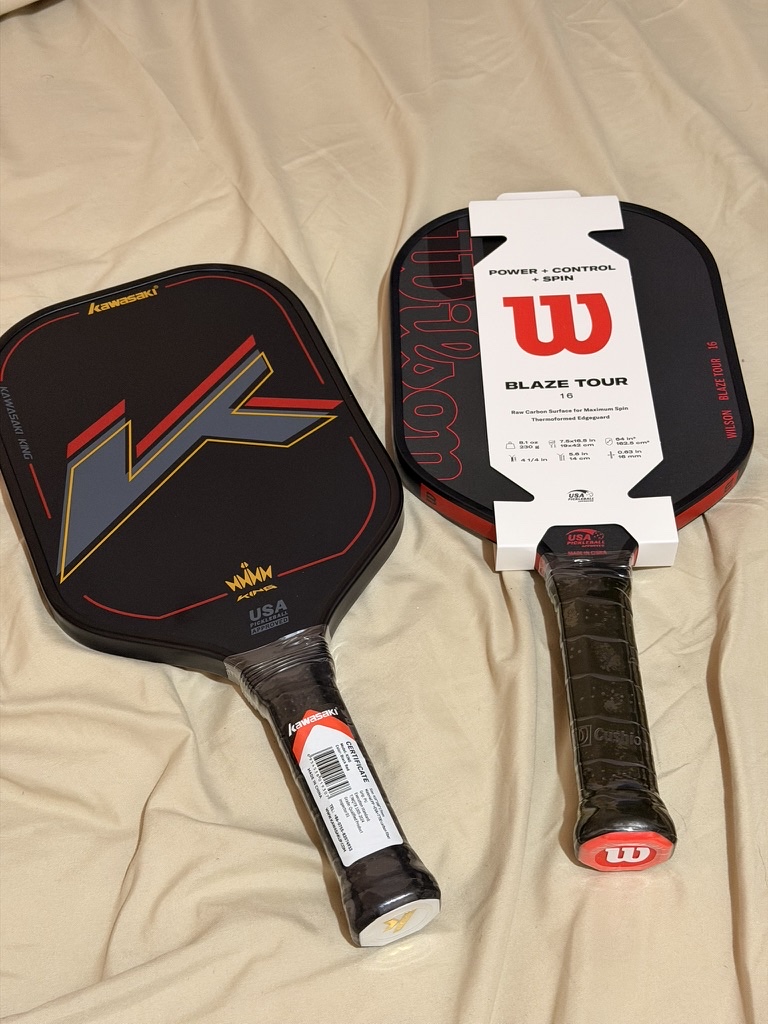
I ordered it before flying back to Cebu. When the box arrived, I unwrapped it on my bed like a kid on Christmas morning.
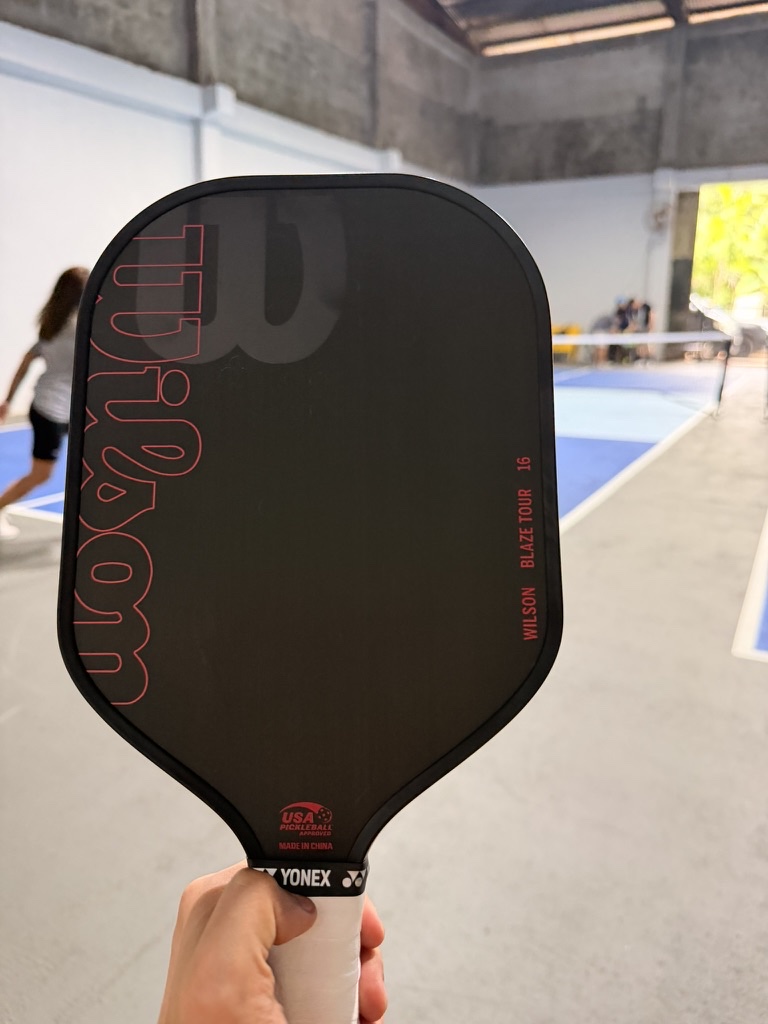
Back in Cebu — and saying yes to my workmates
The first message I sent when I landed in Cebu wasn’t to my family. It was to the workmate group chat. “Hey, when’s the next pickleball night?”
It didn’t take long. Within the week, an invite landed in the chat — same group, same friends I’d been politely declining for months. This time I didn’t hesitate. I said yes, showed up, and you could tell from the smiles around the court that everyone was genuinely pleased I’d finally come around.
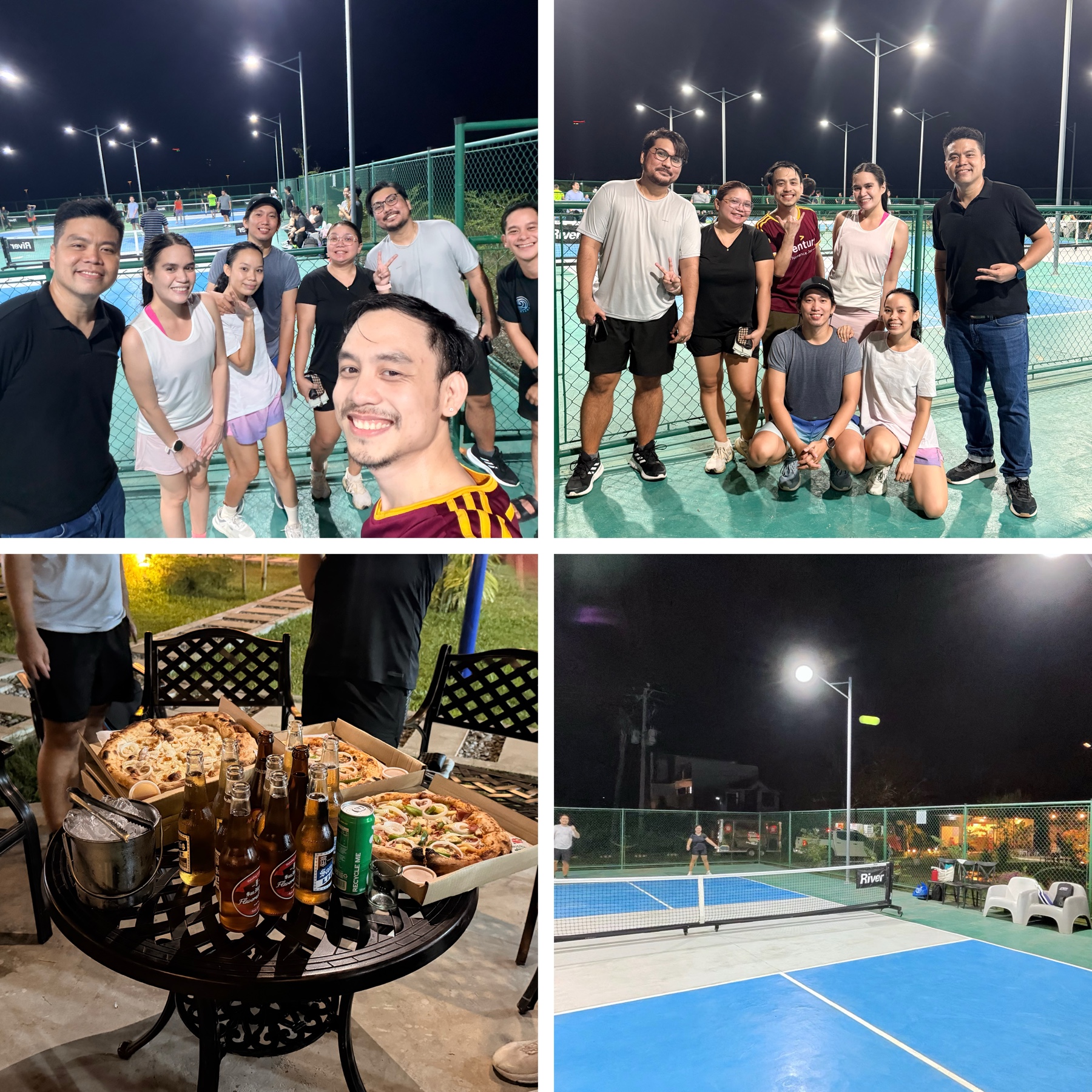
We played four games, switched courts, tried different partners, and somewhere along the way I realized something: the friends I’d been politely declining for months were now the people I most wanted to see on a Wednesday night.
The sport itself is the hook, but the community is what keeps you. People show up because the games are short and the social density is high. You can play with eight different people in a two-hour session. You start the night barely knowing somebody and finish it having dunked on them at the kitchen line three times and become friends.
That’s why pickleball is exploding in the Philippines. Not because the YouTube clips finally got compelling. Because it’s a social sport with a low barrier to entry, a high skill ceiling, and a court small enough to fit anywhere with a flat slab of concrete.
The takeaway
If you’re like I was — invited again and again but always saying no — say yes to the next one. Even if pickleball seems weird at first. Even if you’re not athletic. Even if you’ve already convinced yourself it’s not for you.
Bring shoes that aren’t running shoes (you’ll roll an ankle in those). Don’t buy a paddle yet — borrow one for the first three or four sessions. Learn the two-bounce rule and the kitchen rule on night one. Lose your first ten games. Show up the next night anyway.
And if you end up running the open-play night yourself one day, you know where to find the app that’ll make it easy.
See you on the courts.
— Emman
More from the blog
Why Your Pickleball Open Play Is Unfair (And How to Fix It)
The five reasons pickleball open-play sessions feel unfair — paddle stacking, bracket starvation, mid-tier mismatch, wait-time creep, and dominant pairs — and what to do about each.
Best Pickleball Matchmaking App for Open Play (2026 Guide)
What to look for in a pickleball matchmaking app — and how Picklr compares to the rest. Built for organizers running 2-30 player open-play sessions.
Round Robin vs King of the Court: Which Pickleball Format Should You Run?
Side-by-side comparison of pickleball Round Robin and King of the Court (Challenger's Court) formats — when each works, when each breaks, and how to choose.